George Washington University
Corcoran School of the Arts and Design

George Washington University and the National Gallery of Art partnered on an ambitious, multi-phase modernization of the historic Corcoran Gallery of Art, re-envisioning the 1897 Beaux-Arts landmark as a contemporary home for teaching, exhibitions, and interdisciplinary creative work. Limited as-built documentation made the renovation uniquely challenging, requiring extensive data gathering and modeling to guide design and construction. Mueller and the design team, led by Leo A Daly, employed advanced technologies—including laser scanning, ground penetrating radar, CCT pipe camera surveys, and hygrothermal wall analysis—to develop a comprehensive, highly accurate 3D model of the building’s existing conditions.
Restoring Iconic Galleries While Enhancing Environmental Performance
The project carefully restored the building’s dramatic exhibition halls for National Gallery of Art programming, requiring MEP systems that could meet strict criteria for light control, temperature, humidity, and air quality. Mechanical systems were strategically routed through the attic and concealed pathways to prevent shadows and maintain the galleries’ natural-lighting requirements—one of the project’s most complex engineering challenges.
In addition to the exhibition environments, the university’s program called for specialized HVAC systems to serve art classrooms, labs, studios, and interdisciplinary teaching spaces—all while respecting the building’s historic fabric and meeting modern energy codes.
Integrating Modern Mechanical Systems Within a Constrained Historic Structure
To accommodate new mechanical infrastructure without compromising the building’s architectural integrity, Mueller’s design reimagined an interior courtyard as a three-level equipment platform. This central mechanical hub houses:
-
Outdoor units associated with a new variable refrigerant flow (VRF) system with heat recovery
-
Three DOAS-type air-handling units with exhaust air energy recovery
-
A large VAV air-handling unit with energy recovery
-
A high-efficiency heating hot water plant with three condensing boilers
-
Dust-collection systems for wood and metal shops in the sub-basement
-
A gas-fired emergency generator at the roof level
These systems provide highly controlled environments for mixed-use academic and exhibition functions while improving energy performance and long-term maintainability.
Advanced Controls and Campus Integration
A fully new direct digital building automation system (BAS) was provided to manage and monitor both the new and existing HVAC systems. This BAS integrates with GW’s supervisory control and data acquisition (SCADA) platform, giving facilities staff the ability to track performance, optimize system operation, and maintain the precise environmental conditions required for both fine arts instruction and museum-quality exhibitions.
Through meticulous planning, sophisticated modeling, and sensitive integration of modern mechanical systems, the transformed Corcoran building now supports world-class arts education and nationally significant exhibitions within one of Washington, D.C.’s most treasured architectural landmarks.
Read more about the restoration of the historic Corcoran in Architecture DC and Plumbing Engineer.
Consulting Services
- HVAC Systems
- Cooling & Heating Plants
- Electrical Power
- Feasibility Studies
- Historic Preservation
- Lighting Design
- Plumbing Systems
- Revit
- Sustainable Design
- Value Engineering
Architect
Leo A Daly
Client History
-
2018
Corcoran School of the Arts and Design
-
2006
Potomac House


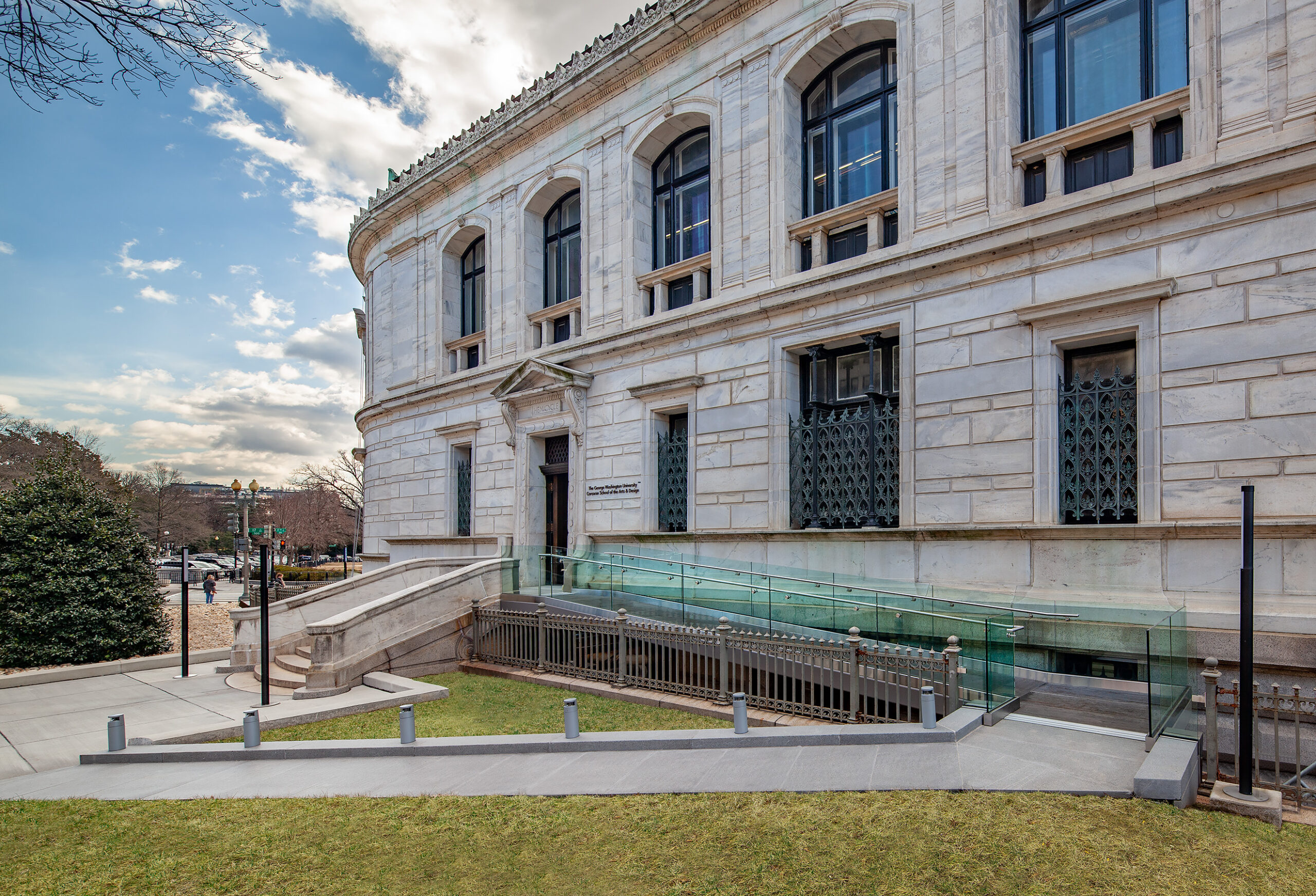

"The success of the first phase is that it's hardly noticeable. Yet with the second, the modern intervention of new teaching spaces within existing, historic galleries is strikingly contemporary without being obtrusive. Combined, these two phases add up to...allowing GWU to continue the Corcoran's mission."Deane MadsonArchitecture DC
Related Projects

Connect With Us

Gain Momentum
Our industry newsletter, Momentum, highlights projects, clients, and MEP and fire protection engineering trends